AI Training
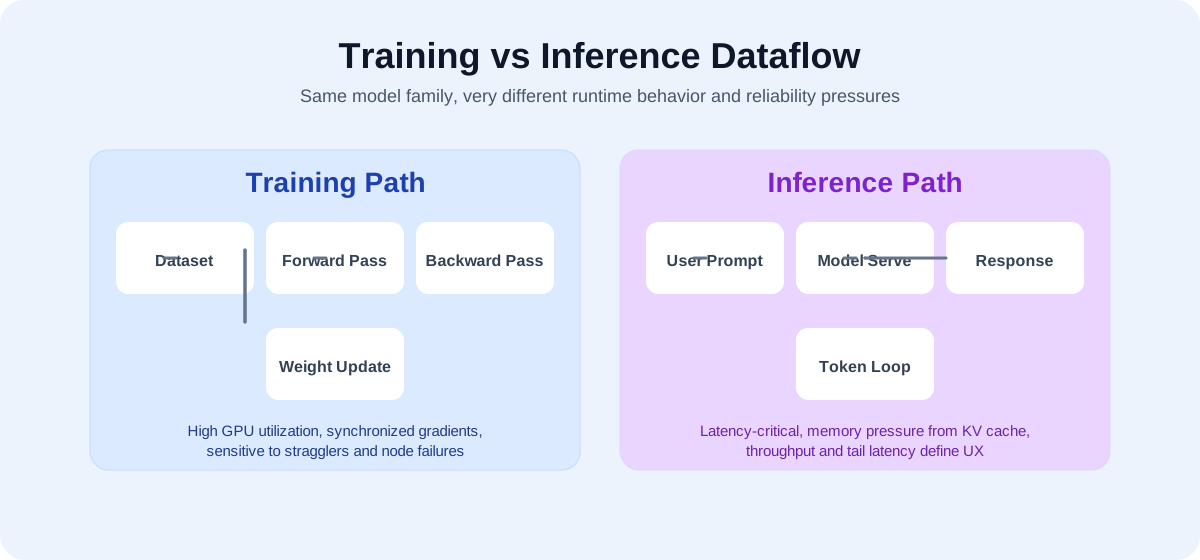
Training updates billions of model parameters over massive datasets. It is compute-heavy, synchronized, and highly sensitive to stragglers.
- •Distributed gradient updates
- •Long-running multi-GPU jobs
- •Barrier synchronization overhead
At Meta scale, 66% of Llama 3 training interruptions were hardware failures — and the worst leave no trace. Silent Data Corruption (SDC) miscomputes gradients while the loss curve still looks fine, wasting weeks of H100 time. FabricBeat detects, triages, and remediates it autonomously.
Meta-scale reliability for AI teams running 64–512 GPUs — without a Meta-sized SRE org.
NaN traps, gradient-variance drift, XID errors & thermal telemetry
Binary-search triage isolates the offending accelerator in seconds
Quarantine the node, restore from hyper-checkpoint, resume clean
FabricBeat is built for modern AI workloads. Training, inference, and deep networks depend on GPU clusters where reliability directly impacts speed, cost, and model delivery timelines.
Training updates billions of model parameters over massive datasets. It is compute-heavy, synchronized, and highly sensitive to stragglers.
Inference serves predictions in real-time. Latency and throughput define user experience and infrastructure cost.
Deep neural networks stack many layers and massive tensor operations. This creates high VRAM demand and communication load.
GPUs accelerate parallel tensor math, but reliability is critical. A single thermal or memory issue can slow an entire cluster.
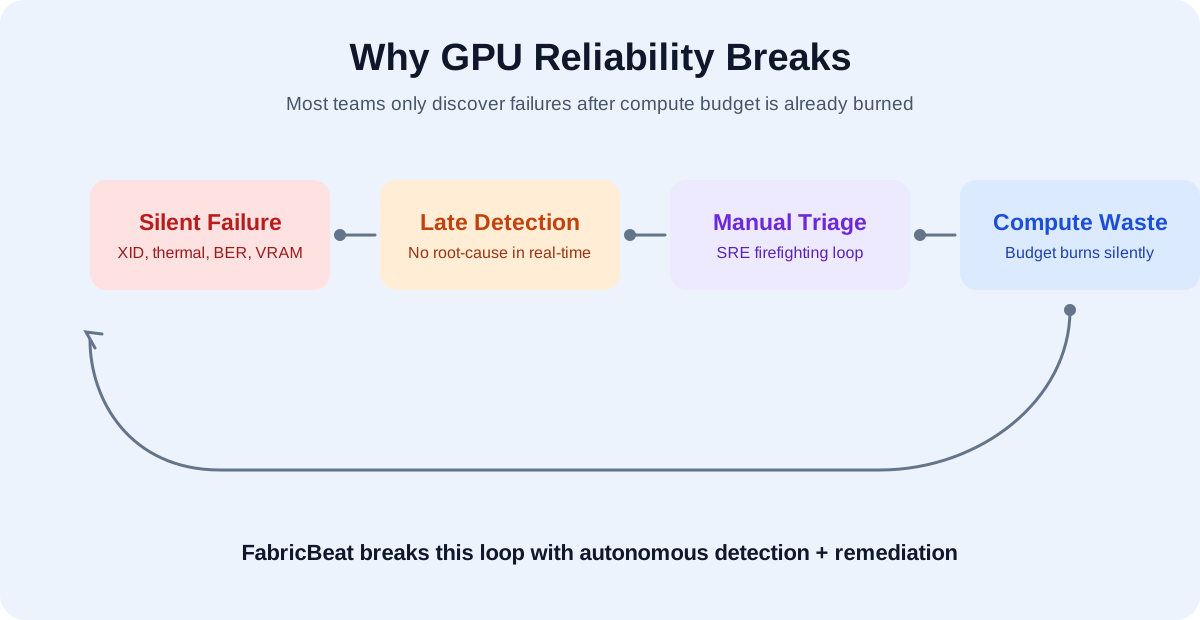
Visible failures halt your cluster — those are the easy ones. The dangerous failures are silent: hardware that miscomputes without leaving a trace, creating an illusion of progress while a multi-week training run quietly diverges.
of Llama 3 training interruptions were hardware failures
accelerators now hit silent data corruption (was 1 in a million)
an SDC can go undetected while compute is wasted
Difficulty rises as failures get quieter. Most tools only see the first two.
A device powers on or it does not. Simple health checks find these. Frequent at scale, but easy to triage and repair.
Load-dependent faults — thermal runaway, uncorrectable-error crashes. Need pattern-matching and traps to reproduce and mitigate.
Hardware miscomputes with no trace. Now ~1 in 1,000 accelerators. The application happily consumes wrong results — for weeks.
A single bad accelerator generates a NaN that contaminates the iteration, then the host, then the entire cluster — forcing a halt. The source is one computation hidden among thousands of nodes.
Worse: values stay within numeric bounds, so no NaN trap fires. Training shows an illusion of progress while silently diverging. It can take weeks or months to even notice.
In inference, the same corruption silently flows into recommendations and LLM outputs — affecting thousands of consumers and bypassing privacy and integrity boundaries.
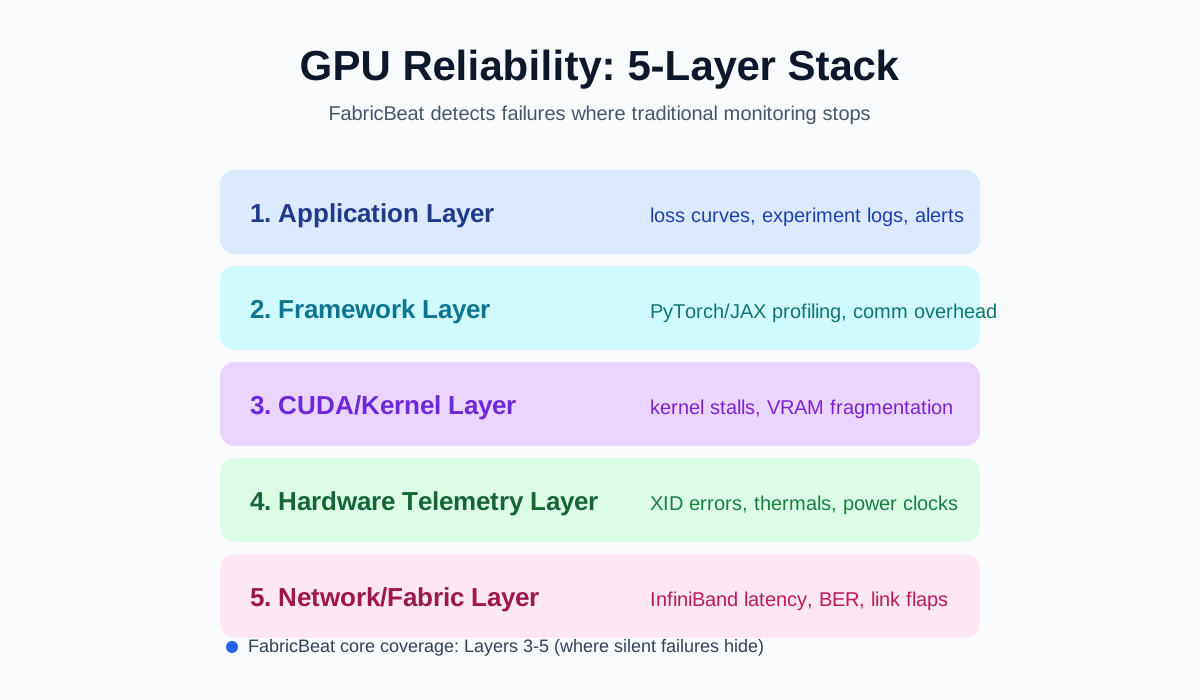
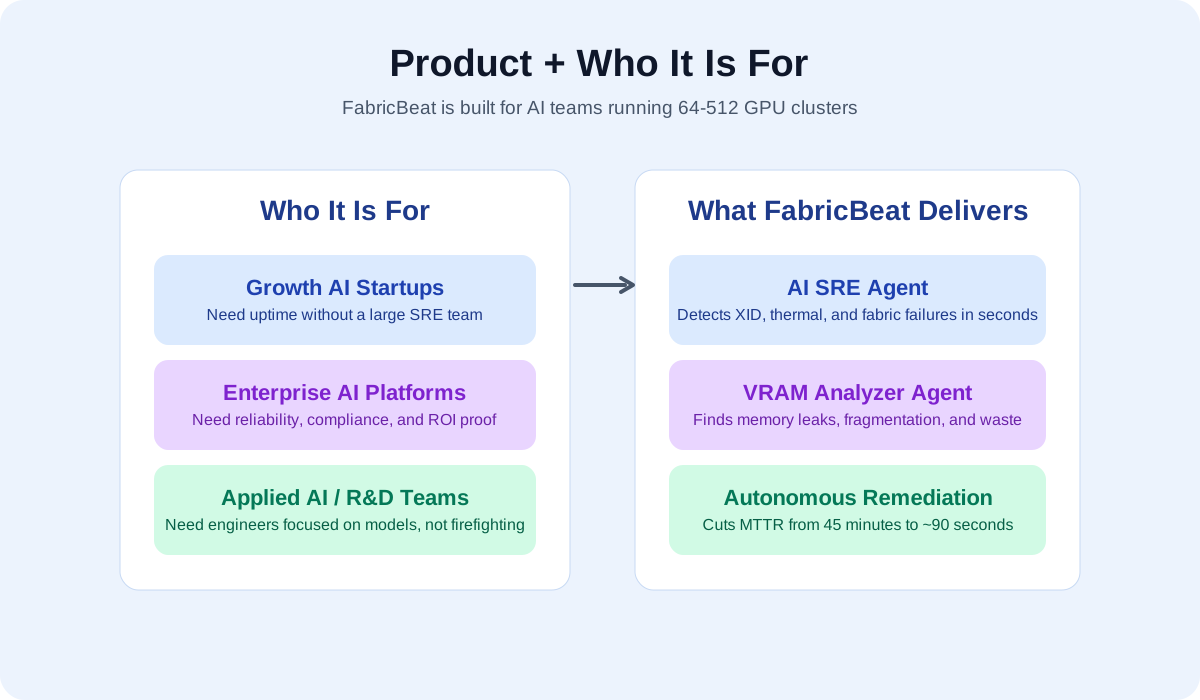
AI teams running 64-512 GPUs: startups scaling training infra, enterprise AI platforms, and labs that cannot afford Meta-sized SRE teams but still need high reliability.
Autonomous SRE agents watch for NaN traps and gradient-variance drift, run binary-search triage to isolate the offending accelerator, quarantine it, and resume from a hyper-checkpoint — automatically.
We're not replacing Datadog or W&B. We're solving the GPU reliability problem they don't address—because autonomous remediation requires hardware-level telemetry.
| Feature | FabricBeat | Datadog | W&B | CloudWatch |
|---|---|---|---|---|
| Silent Data Corruption Detection | ||||
| Zero-Downtime Analytical Detection (no test allocations) | ||||
| NaN Propagation Trapping | ||||
| Gradient Divergence Detection | ||||
| Reductive (Binary-Search) Triage | ||||
| Hyper-Checkpointing & Clean Resume |
| Feature | FabricBeat | Datadog | W&B | CloudWatch |
|---|---|---|---|---|
| XID Error Detection | ||||
| Optical BER Monitoring | ||||
| VRAM Fragmentation Analysis | ||||
| NVLink Throughput |
| Feature | FabricBeat | Datadog | W&B | CloudWatch |
|---|---|---|---|---|
| Auto Node Cordoning | ||||
| Checkpoint Triggering | ||||
| Warm Spare Orchestration | ||||
| LLM-Powered Root Cause |
| Feature | FabricBeat | Datadog | W&B | CloudWatch |
|---|---|---|---|---|
| Experiment Tracking | ||||
| Model Artifact Storage | ||||
| Hyperparameter Tuning |
Autonomous GPU SRE
Strengths:
Limitations:
Pricing:
$2,000/node/year
Observability Platform
Strengths:
Limitations:
Pricing:
$31/host/month + logs
ML Experiment Tracking
Strengths:
Limitations:
Pricing:
$50/user/month
AWS Native Monitoring
Strengths:
Limitations:
Pricing:
Pay-per-use
Use Datadog for APM. Use W&B for experiments. Use FabricBeat to keep your $250/hour cluster actually running.
We're complementary, not competitive. Our agents sit on your nodes and catch the silent data corruption that Datadog can't detect and W&B can't remediate — before it poisons a multi-week training run.
Sense. Think. Act. Catch silent corruption mid-run — not weeks later when the model is already poisoned.
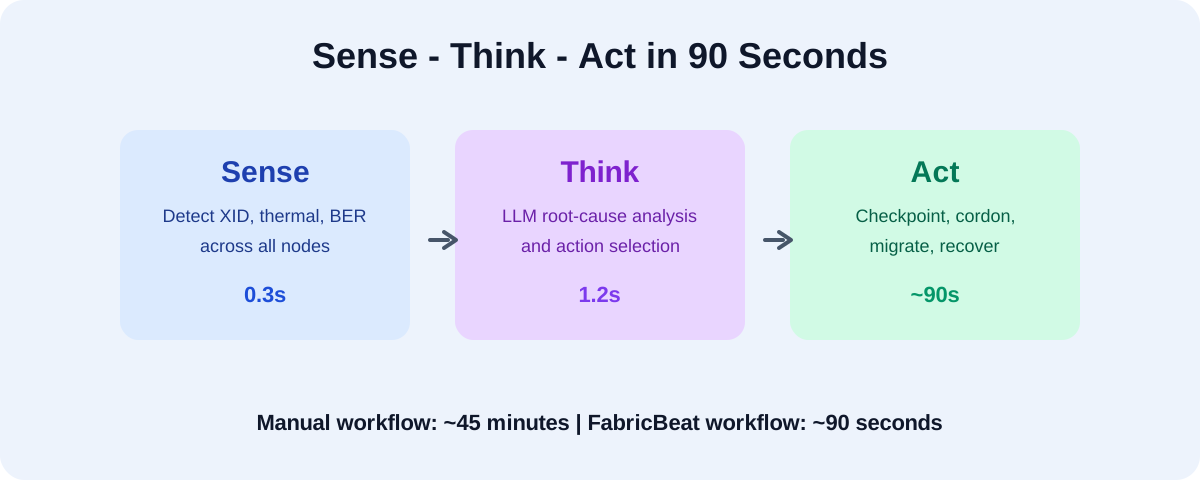
Gradient variance on GPU #7 drifts outside its learned distribution — no NaN, no crash, loss curve still looks normal. A divergence detector flags a probable silent data corruption (SDC).
Reductive triage: replay mini-iterations across progressively smaller node groups (binary search) to reproduce the corruption and isolate the single offending accelerator amid 64 GPUs.
Quarantine the bad node, reconstitute the cluster with a healthy spare, and resume from the latest hyper-checkpoint — before corrupted gradients aggregate into an unrecoverable divergence.
Caught mid-run — one corrupted accelerator isolated
vs. weeks of silent divergence and a wasted training run
Recovered $100K+ of H100 compute that would have trained a poisoned model
FabricBeat brings Meta-scale silent-data-corruption defenses to AI teams operating 64-512 GPUs — enterprise reliability without building a massive SRE org.
Full-Stack Site Reliability Engineer
Tools:
Output:
Passive, test-agnostic SDC detection — no diagnostic downtime — plus NaN propagation, gradient drift, XID errors, thermal
Tools:
Output:
Distinguishes a benign transient from a real SDC, then isolates the single offending accelerator amid 64+ GPUs.
Tools:
Output:
Quarantine the corrupting node, resume from a clean hyper-checkpoint, contain NaN propagation before it halts the cluster
Sense: Loss curve looks healthy, but gradient variance on one accelerator drifts outside its learned distribution — no NaN, no crash. Divergence detector flags a probable SDC.
Think: Agent reasons: "Within numeric bounds, so no NaN trap fired. Run reductive triage — binary-search mini-iterations to reproduce and isolate the offending GPU before gradients aggregate."
Act: Quarantines the corrupting node → reconstitutes cluster with a healthy spare → resumes from the latest hyper-checkpoint. The run is saved instead of silently training a poisoned model for weeks.
Most SDC detection steals compute to run diagnostic tests. FabricBeat also watches application exceptions in kernel space — flagging core-concentrated crash patterns (CCKC) that indict a defective accelerator with no test allocations and no paused training. This analytical approach has been shown to outperform test-based detection by 41%.
Approach inspired by hyperscaler reliability research — Dutta et al., "Hardware Sentinel," ASPLOS '25, and Meta's published SDC detection work.
The "HeapHero" for GPU Memory
Finds stale tensors left in VRAM after failed inference calls
Java Equivalent:
Heap leak detection (finds objects not GC'd)
Example:
4GB of zombie KV-caches from 12 timed-out sessions
Identifies 95% fragmented VRAM (12GB free but unusable)
Java Equivalent:
Heap fragmentation analysis
Example:
15,000 tiny holes preventing 2MB+ tensor allocation
Spots duplicate weights from inefficient DataParallel splits
Java Equivalent:
Finding duplicate HashMaps wasting space
Example:
Layers 12-24 duplicated, wasting 8GB
Identifies FP32 layers that could be INT8
Java Equivalent:
Excessive object size analysis
Example:
Layer 45: FP32→INT8 saves 1.2GB with <0.1% accuracy loss
⚠️ Cluster Node #04 (AWS g5.12xlarge)
Status: Critical - OOM Predicted in 14 minutes
• 95.2% Fragmentation: 12GB free but split into 15,000 holes
• Stale KV-Cache: 4GB held by 12 zombie sessions (timed out 20min ago)
• Redundant Weights: Layers 12-24 duplicated due to inefficient split
Autonomous Action Plan:
✅ Triggered defragmentation (cuMemAddressReserve)
⏳ Evicting zombies (session IDs: #402, #405, #410)
🚀 Suggest: Convert Layer 45 from FP32→INT8 (saves 1.2GB, <0.1% accuracy loss)
NVIDIA DCGM
Hardware telemetry
LLM Reasoning
GPT-4o / Claude
Kubernetes
Orchestration
Java Control
Mission-critical
Silent data corruption and unrecovered failures quietly tax your GPU budget. FabricBeat combines autonomous SDC detection and remediation with hard-dollar economics to recover it.
Industry average: GPU clusters waste 22% of compute hours on silent data corruption, unrecovered failures, and manual triage. For a 64-GPU H100 cluster, that's $481,029 per year down the drain.
Meta's research found that 66% of Llama 3 training interruptions were hardware failures, and that silent data corruption — now ~1 in 1,000 accelerators — corrupts training runs that are only discovered weeks later.Read their engineering blog →
Miscomputed gradients with no NaN or crash — training diverges silently for weeks
NaN propagation or NCCL timeouts halt the cluster at 0% useful work
1 GPU running hot slows the entire cluster via global barriers
Optical degradation causes RDMA failures; 95% fragmentation → OOM despite "free" VRAM
Total Annual Waste
$481,029
FabricBeat Recovers
85%
Value Recovered
$408,875
Cluster Cost
$2,186,496/year
$249.6/hour × 8,760 hours
Current Waste (22%)
$481,029/year
Silent data corruption + stalls + thermal
FabricBeat Cost
$16,000/year
8 nodes × $2,000/node
Waste Recovered
$408,875/year
85% of $481,029 recovered
Net Annual Savings
$392,875
Recovered - FabricBeat cost
Return on Investment
2,455%
Payback in 0.5 months
For every $1 spent on FabricBeat, you recover $25.55 in wasted GPU compute.
The question isn't "Can we afford FabricBeat?"
It's "Can we afford to keep wasting $481K/year?"
You're losing 22% of your GPU budget to silent data corruption, unrecovered failures, and manual triage. Calculate what FabricBeat can recover.
Based on 85% waste recovery rate
Join leading AI labs running 64-512 GPU clusters who trust FabricBeat to eliminate the 22% reliability tax and recover $100K+ per training run.
Questions? Email us at hello@fabricbeat.com